
Celene's thoughts on consciousness
contra scott alexander (?)

Yesterday, I went to the Berkeley ACX Meetup. Scott Alexander was there, and ran a Q&A session where participants could ask him questions and he would respond to them unless the questions were about eulogies, in which case he would pause to think for a few seconds before kindly passing. At one point or another, the questions drifted to theories of consciousness.
As a kind-of-illusionist, I worked up the courage to raise my hand and ask him what I should do if I wasn’t sure if I was conscious. Everybody laughed at this question, and while I expected Scott to respond to the philosophical point, he instead said (paraphrased from memory, may not be accurate),
I actually don’t think that’s a funny question. I know of one historical example of someone who got into a traumatic accident, and afterwards claimed that he stopped being conscious. He behaved fully normally otherwise, except for the part where he was like, “It’s really messed up how I’m not conscious now.” And so, I think it’s kind of like aphantasia, right, where some people have a harder time visualizing things, or [I don’t remember if the other example he gave was anosognosia or somatoparaphrenia, but I think it was one of them]. And it’s well known that people who have had traumatic experiences can experience less rich and intense sensations, that people with depression can experience their vision as being washed out, and less colorful. I think that along with this, people who have been traumatized might also have a less rich sense of being conscious. So if you’re actually asking for advice, I’d say, “Check if you’re traumatized, and then if you are, do standard trauma-informed therapy.”
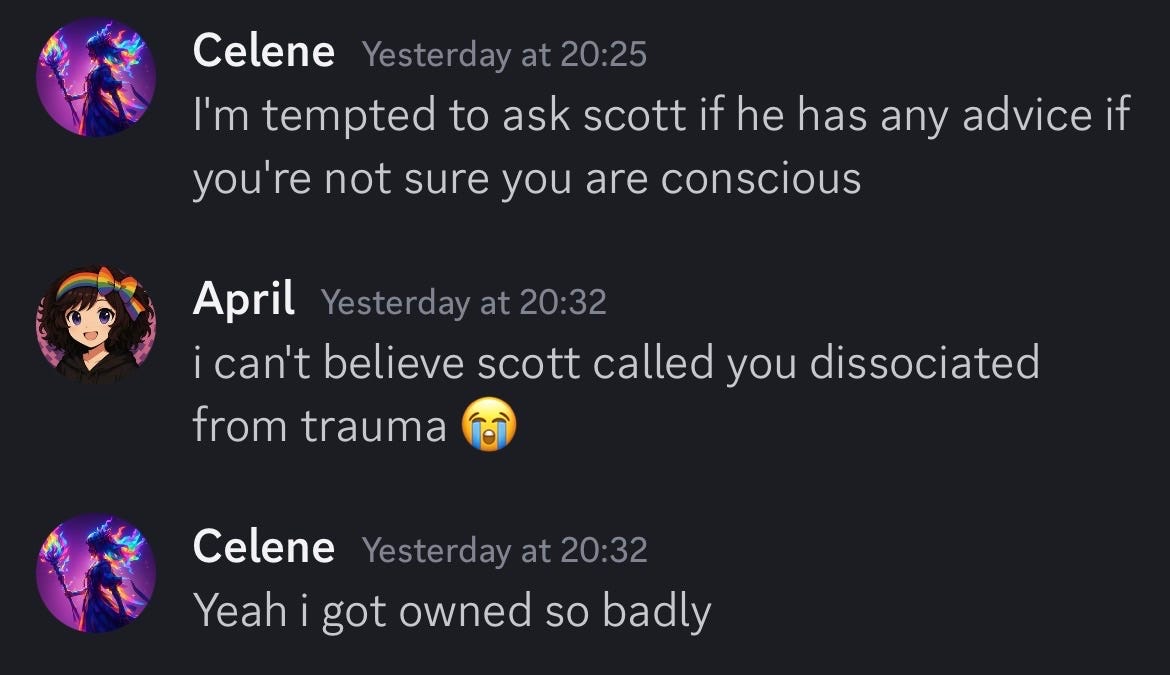
Now, this was such an epic roast1 that it took me several minutes to work up the courage to raise my hand again, and clarify that I actually wanted to hear his thoughts on illusionism.
You mean, the idea that no one is conscious? …I think that people generally have a very strong, innate felt sense of consciousness. So if you think that people aren’t conscious, I’d be curious to know exactly how you’re defining “consciousness” such that you believe people don’t have it.
At this point, I had already asked him two questions about this, I was still reeling from his first response, and I didn’t want to devolve the entire Q&A into a discussion on consciousness between Scott and I, so I sat meekly there for the rest of the meetup. However, this meant I did not actually get a chance to discuss my theories of consciousness, so now I am inflicting it on my online audience.
What is consciousness?
I think Scott’s challenge, asking how I would define consciousness such that people don’t have it, is entirely fair. This is also how I would respond to people who claim that free will is nonexistent, for example. Unfortunately, I don’t have a good response to this question. This is primarily because every time I ask someone what they mean when they say consciousness, they either have their own theory about what it entails and what causes it, which differs from everybody else’s theories, or they say, “I don’t know, you can kind of just feel it, man.” While I can’t dispute the “just feel it, man” argument, I am kind of confused about how we all collectively agreed to refer to the exact same feeling as “consciousness” while the details of it are in such great dispute. Also, no, I don’t just feel it, man. Sorry about that. Maybe I’m traumatized!
Consciousness as subjective experience
I agree that I have access to sensory inputs which other people don’t have access to. As I understand it, this fulfills the “subjective” part of “subjective experience”, but so does a camera (Yes, you can then go and view the image later, but a talented artist can also draw a very detailed reproduction of what they’re seeing, so clearly that’s not disqualifying). I’m a bit less sure about what the “experience” part of this refers to. I understand what the word means in other contexts, but in my [WORD THAT IS NOT EXPERIENCE], when I press people on this point they say, “It’s obvious!” It is, unfortunately, not obvious to me. Maybe everybody else had a meeting where they agreed to use “experience” to refer to this obvious thing, and I missed it?
Ok, but this is kind of a degenerate case of “subjective experience”. Clearly, when people say “subjective experience” they refer to… some sort of internal state of being that isn’t understandable from the outside? Like thoughts, or feelings? Do they have to be undetectable with an MRI?
Wikipedia’s page on subjective character of experience suggests that the term was coined by Thomas Nagel, so presumably he has a definition. Let’s see what Mr. Nagel has to say!
Conscious experience is a widespread phenomenon. It occurs at many levels of animal life, though we cannot be sure of its presence in the simpler organisms, and it is very difficult to say in general what provides evidence of it. (Some extremists have been prepared to deny it even of mammals other than man.) No doubt it occurs in countless forms totally unimaginable to us, on other planets in other solar systems throughout the universe. But no matter how the form may vary, the fact that an organism has conscious experience at all means, basically, that there is something it is like to be that organism. There may be further implications about the form of the experience; there may even (though I doubt it) be implications about the behavior of the organism. But fundamentally an organism has conscious mental states if and only if there is something that it is like to be that organism—something it is like for the organism.
We may call this the subjective character of experience. It is not captured by any of the familiar, recently devised reductive analyses of the mental, for all of them are logically compatible with its absence. It is not analyzable in terms of any explanatory system of functional states, or intentional states, since these could be ascribed to robots or automata that behaved like people though they experienced nothing.
It is not analyzable in terms of the causal role of experiences in relation to typical human behavior—for similar reasons I do not deny that conscious mental states and events cause behavior, nor that they may be given functional characterizations. I deny only that this kind of thing exhausts their analysis. Any reductionist program has to to be based on an analysis of what is to be reduced. If the analysis leaves something out, the problem will be falsely posed. It is useless to base the defense of materialism on any analysis of mental phenomena that fails to deal explicitly with their subjective character.
I assume we all believe that bats have experience. After all, they are mammals, and there is no more doubt that they have experience than that mice or pigeons or whales have experience. I have chosen bats instead of wasps or flounders because if one travels too far down the phylogenetic tree, people gradually shed their faith that there is experience there at all
If extremists are prepared to deny it of mammals other than man, then we are forced to face the question, “What am I, chopped liver?” It seems Nagel doesn’t have a definition either, other than “I don’t know, you can just feel it, man”. As someone who has shed my faith that there is experience there at all at this juncture in the phylogenetic tree, it seems I unfortunately cannot find my salvation in Nagel.
Mary’s Room
Mary’s room, also known as the knowledge argument, is a famous thought experiment posed by Frank Jackson in 1982, as an argument against physicalism. In this case, it can also serve as an argument against illusionism. In its original formulation, he writes:
Mary is a brilliant scientist who is, for whatever reason, forced to investigate the world from a black and white room via a black and white television monitor. She specialises in the neurophysiology of vision and acquires, let us suppose, all the physical information there is to obtain about what goes on when we see ripe tomatoes, or the sky, and use terms like ‘red’, ‘blue’, and so on...What will happen when Mary is released from her black and white room or is given a colour television monitor? Will she learn anything or not?
Now, I do have a strong intuitive sense that Mary will learn something new upon leaving the room. It might seem like we’ve finally found qualia/consciousness/sentience/whatever, but the thought experiment has been around for a while, and physicalists have already come up with a few common responses to it.
The ability hypothesis says, “Well, imagine that you spend all your time reading every snowboarding2 guide ever published, watching countless snowboarding videos, reading every academic text published on snowboarding. Do you know how to snowboard? No? Well this is stupid, then.”
The acquaintance hypothesis, by Earl Conee, claims that the knowledge Mary gains is not factual knowledge, nor is it an ability, but rather a third type of knowledge, which he dubs “acquaintance knowledge.” Acquaintance knowledge “requires the person to be familiar with the known entity in the most direct way that it is possible for a person to be aware of that thing”. This might be a helpful definition for people who intuitively know what he means by “the most direct way that it is possible”, but unfortunately I yet again do not.
The old fact/new guise analysis suggests that Mary doesn’t learn anything new, but instead learns a new understanding of what she already knew. Now, I’m not entirely sure what it means to not learn something new but instead to learn something new. Amy Kind, who laid out these three different responses3 in her book, “Philosophy of Mind: The Basics", cites the example that you might know Bruce Wayne is 6’2” tall, but you can also express this by saying that Batman is 6’2”, or that “Bruce Wayne mesure 1.8796 mètres“. Now, I’m pretty sure for the first one you would need to have the knowledge that Bruce Wayne is Batman, and for the second one you would need to know how to speak French and convert between the imperial and metric systems, so unfortunately I don’t really understand what this is saying.
All in all, I would agree with the ability hypothesis the most, or perhaps with Daniel Dennett’s claim (I believe this is from Consciousness Explained, although I am not sure) that actually our intuitive sense that she would learn something is wrong, because we’re bad at imagining a Mary who actually knew everything there is to know about vision.
Molyneux’s Puzzle
In the 17th century, philosopher William Molyneux asked John Locke, “Let’s say that someone born blind learned to distinguish objects by touch. For example, they might be able to tell the difference between cubes and spheres. Now, if we restored the blind man’s sight, would they be able to tell which was which by sight alone?”
Molyneux’s wife was blind, which might have inspired him to pose this question. Locke argued that they wouldn’t be able to tell, because vision and touch are different senses, and this has been the subject of much scholarly debate over the past few centuries.
Interestingly enough, we can just test this now! We have developed the ability to restore the sight of those born congenital blind, and in fact, someone has already ran the experiment. The answer is a very loud and resounding, “No”. They actually really suck at it, although obviously, they improved with time.
Now, obviously, these blind children were not academic experts in neurology or in human vision, but this does seem to me to be some evidence towards the ability hypothesis.
Consciousness as self awareness
Some people claim that consciousness is the capacity for introspection. I agree that I am capable of modeling and thinking about myself. If that was all there is to it, I would agree that I am conscious, and that consciousness exists. However, it seems that a lot of people seem to ascribe further phenomenological properties to this, which I am somewhat skeptical about.
Furthermore, what exactly do we mean by self awareness? Is a quine conscious? Is the sentence, “I am this sentence” conscious? Is This Is the Title of This Story, Which Is Also Found Several Times in the Story Itself conscious? Certainly they are self referential, but are they aware? What is the requirement for awareness? These questions seem to circle back again on the idea of qualia, which I don’t know about.
Computational consciousness
There are many schools of thoughts around consciousness. For example, maybe you believe the universe is fundamentally physical, and that consciousness is a physical phenomenon, in which case you would be a physicalist. Perhaps you believe that the universe is fundamentally mental or experiential, in which case you would be an idealist. Perhaps you think, “Eh, why not a bit of both,” in which case you would be a dualist. Now, in the rationalist community, we are primarily physicalists, and a specific popular theory is computational theory of mind, the idea that consciousness arises from computation. I used to be a big proponent of this theory, and it is still my top contender for the source of consciousness, if such a thing does exist.
Against Epiphenomenalism
Epiphenomenalism suggests that mental states are caused by physical states, but don’t have any impact on the physical world whatsoever. This is a very appealing philosophy, because it allows you to believe in consciousness while still being a physicalist, and conveniently you don’t have to think about its impacts on anything, or empirically verify any of your theories about the source of consciousness. However, I unfortunately think it is wrong.
Eliezer Yudkowsky has already critiqued this theory at great length, but in essence, the problem with this is at there is no reason to believe in consciousness. After all, if it can’t impact the physical world, that means any claims I make about being conscious must be completely unrelated to whether or not I actually am conscious. If I were conscious, I would claim to be and act like I am conscious, and if I were not conscious, I would also do that. Now, you could argue that in the first case the belief would be a justified belief, and in the second case it would be an unjustified belief. However I am personally skeptical of the idea that if these two cases cannot be distinguished, you can still have one belief be justified and the other unjustified.
You could also argue that if I am not conscious then nothing matters, and so I might as well act as if I am conscious. This, however, is smuggling in an implicit value system in which I only care about worlds in which I am conscious, which is perhaps true, but it does seem a little strange to me to claim that there is a mysterious phenomenon whose existence or absence thereof cannot be detected, and for whom I might as well act the same way no matter what, but trust me it is definitely an important phenomenon.
Eliezer has some other arguments against epiphenomenalism which are more exhaustive than the ones I’ve listed here, but these are the ones I find most compelling.
Fully Homomorphic Encryption
Recently, I have come across an argument that computational notions of consciousness may be weirder and more unintuitive than one might naively think. The immortal Autumn “adrusi” Russell writes:
old autumn thought experiment, riff on the chinese room:
what is the nature of an ai (or a computer simulation of a human mind, if you prefer) if it is embedded within a fully homomorphic encryption system? is it intelligent? does it have subjective experience?
for those unfamiliar, fully homomorphic encryption is a type of encryption where it's possible to perform arbitrary computation on encrypted data
an FHE system provides the procedures ENCODE, DECODE and EMBED such that DECODE(key, EMBED(f)(ENCODE(key, data))) = f(data) for any computable function f
it's used in real commercial applications, and encrypted data cant be decoded without the key (the catch is that it imposes an overhead of about 1000x on the speed of computation with current methods)
if f is an ai, then EMBED(f) is a program that takes as input a string of data that — if you dont have the key — is indistinguishable from random noise, and spits out different data indistinguishable from random noise
say we assume that f, the original ai, is intelligent, understands the data it operates on, and has subjective experience. does embed(f) understand the data it operates on? does it have subjective experience?
from the perspective of someone who has the key, the data the embedded ai operates on is meaningful. we might think of it as analogous to translating the input from english to chinese, feeding it to the embedded ai, and then translating the output from chinese to english. naively wed think anything that could produce intelligent responses would have to understand the data that it's operating on
but the embedded ai does not know chinese in this analogy (it has no knowledge of the key) and moreover, the machine that created it by transforming the original ai ALSO doesnt know anything about the key. naively wed think theres no way that it could understand the data it operates on — the key hasnt touched its causal history
but unlike searles chinese room, we know that the operation of the embedded ai is conjugate to the operation of a system that *does* understand the data it operates on
and turning to the question of subjective experience: if the embedded ai has any experience, what is it that it's experiencing? from its perspective, all its input and output is indistinguishable from random noise. does it feel like it's having a seizure all the time?
i have my own analyses, of course, but i think it'd be more fun if i left it open to the replies, if anyone is interested
I find this to be a very compelling argument. If a homomorphically encrypted system is conscious, then it must be the encrypted computation that is conscious, not the decryption, since decrypting text probably doesn’t produce consciousness. If we accept this argument, it suggests that any computational theory of mind must necessarily be input-agnostic, which I imagine does not mesh well with many people’s intuitions about consciousness.
However, maybe you are willing to bite this bullet, and you believe in a theory of consciousness that is fully input-agnostic, such that your sensory inputs are directly unrelated to your conscious experience. If this is the case for you, please comment, because I would love to hear more about your theories.
There are a few responses you could make to Autumn’s argument, though.
Consciousness is non-atomic
If homomorphically encrypted systems are conscious, then they are conscious only when decrypted. That is, neither the homomorphic computation itself nor the decryption process in isolation produce consciousness, but they produce consciousness when combined. This would be very strange and unintuitive to me, since you could do the homomorphic encryption, wait a hundred years, and then decrypt it then, and it would maybe imply some sort of metaphysical phenomenon tracking which strings were previously produced by homomorphically encrypted conscious systems, but maybe my intuition is wrong. Under this theory, if you do homomorphic computation of a conscious mind and then decrypt it with a completely different key, then presumably(?) you just get the experience of having had a different input
Homomorphically encrypted minds are not conscious
This is also a reasonable stance to take. It does imply that p-zombies are possible, which is a violation of Eliezer’s General Anti-Zombie Principle, but maybe you think that principle is wrong. Personally, I don’t, and it runs into the same problems discussed earlier with epiphenomenalism, since homomorphically encrypted minds would still necessarily believe that they were conscious.
Full Homomorphic Encryption as described is impossible for XYZ reasons
I don’t know if this is actually possible or relevant, but I am including it for the sake of completeness. If anyone has studied this more than I have please tell me in the comments!
Just feel it, man
I’m not really sure to what degree my arguments have been convincing. Perhaps you have fully bought into my arguments for illusionism and no longer believe in consciousness. Perhaps you understand them, and maybe found the FHE argument thought-provoking, but feel like I am missing something fundamental about the nature of experience, but you find it hard to articulate. Maybe you find it very easy to articulate what I am missing, in which case please tell me!
However, I am now forced to face the actual argument that Scott made in his response to me: Most people seem to think that consciousness is a thing that is real! What if I am merely missing out on a core part of the human experience, due to some form of trauma that I may or may not have encountered in my past?4
And indeed, meditators around the world, along with recreational drug users the Qualia Research Institute, have all made fascinating claims about their own experiences of consciousness in relation to these activities. One friend of mine claimed to me that they have experienced their consciousness changing in type (in the type theory sense), and being “type punned”. I’m not entirely sure what this is supposed to mean, either from a type theory perspective or from a consciousness perspective, but it was interesting so I thought I would share it.
There have been many other fascinating reports from this sphere.5 This post ostensibly6 describes what cessation is like. This is another report, describing something similar. Other reports have described feeling on drug trips as if their qualia are being "being outputted into the universe" rather than strictly internal. One friend of mine reported that they have heard of people experiencing cessation of consciousness on ketamine, of the same type as caused by general anesthesia. For some reason, I find that particular report extremely easy to believe.
Surely it’s impossible that people would come up with the concept of consciousness in the first place if it didn’t actually exist, or that billions of people around the world would hear it and agree with it, just because it was claimed to them that it was a thing they had. And as I type this sentence I recognize the absurdity of it, because actually of course they would, and I find that entirely plausible. Human beings are well known for being confused, or bad at philosophy, and so on, and unfortunately all of the evidence I have seen could very well be explained by saying “idk people are kind of crazy”.7
But of course, this goes the other way as well. I have no idea whether or not I am simply missing some important experience, such that if I had it, I would automatically believe in consciousness. However, I don’t think this sort of “get out of the car” argument makes for very good epistemology, because it is always indistinguishable from the outside whether or not such an experience actually serves as empirical evidence or merely convinces you in some unempirical way. Additionally, you can always argue that the other person simply didn’t try hard enough. It reminds me a lot of religious people claiming that you just need to “Accept God into your heart”, and that the only reason why people are atheists is because they have not chosen to look at the evidence.
However, I do think Scott’s advice is probably correct, since it seems unlikely that trauma informed therapy could convince me of the existence of consciousness in an unempirical fashion unless the therapist is really bad and I am really stupid, and so it seems worth testing.
The Zombie Preacher of Somerset
I was thankfully able to track down8 the historical example Scott mentioned in his response to me. It turns out he had already written about it on LessWrong, over a decade ago. I don’t want to repeat his entire post, but I will briefly summarize it here.
Simon Browne was a much-beloved pastor of a church, when one night, he accidentally killed a highway robber. The traumatic nature of this event caused him to become
...perfectly empty of all thought, reflection, conscience, and consideration, entirely destitute of the knowledge of God and Christ, unable to look backward or forward, or inward or outward, having no conviction of sin or duty, no capacity of reviewing his conduct, and, in a word, without any principles of religion or even of reason, and without the common sentiments or affections of human nature, insensible even to the good things of life, incapable of tasting any present enjoyments, or expecting future ones...all body, without so much as the remembrance of the ruins of that mind I was once a tenant in...and the thinking being that was in me is, by a consumption continual, now wholly perished and come to nothing.
Unfortunately, reading his testimony does not inspire me with the greatest confidence in his ability to accurately assess his own state of mind. He claimed to have been “damned” and that his soul had been “removed from his body”, which suggests to me that his conception of consciousness was very entangled with his religious identity, and indeed caused by his religious beliefs. I could very easily believe that someone who murdered someone and then described experiencing a severing of their connection to God and morality and feeling like they were damned and soulless was simply experiencing extreme guilt over their ego-dystonic actions, rather than something more phenomenologically fundamental. Thus, I am placing his situation into the “idk people are kind of crazy” bucket.
Final thoughts
What do we know about “consciousness”?
Many people report experiencing some sort of “consciousness” phenomenon, or having a strong sense of being “conscious”
The phenomena described under “consciousness” are fairly diverse and in dispute, but nevertheless most people agree to use the word even if they might disagree on the details of the phenomena.
Descriptions of “consciousness” and theories of its source tend to cluster around things involving memory formation, the ability to take sensory input, the ability to think and feel, the ability for introspection, and the “experience” of doing these things.
Additionally, many people have disparate theories about the specific causes of these phenomena, as well as the cause of the sense of consciousness
I am, obviously, not skeptical of humans possessing the abilities to take in sensory input. I am also provisionally willing to accept that the strong conviction in being “conscious” reflects some sort of real phenomenon. What I am more skeptical of is the described link between that phenomenon and the things people believe about that phenomenon, just as I believe that people who profess to possess a soul or a spiritual connection to God describe a real experience, while not necessarily believing their claims about that experience.
Of course, it could be the case that I’m entirely wrong about all of this. When possible I will take Scott’s advice and seek out trauma informed therapy, and report back to you with the results.
Possible responses from readers
Are you sure you’re not just traumatized?
Yes, yes, I got so incredibly owned.
Consciousness is so intuitively obvious that I’m starting to suspect that everybody is conscious except for you, because only a truly unconscious person could think they weren’t conscious.
I would find this unlikely and somewhat surprising, but I suppose it could be true. My friends sometimes joke about this being the case.
Does this mean we can torture you?
You can do whatever you want forever! It’s possible I might object to it, but I’m sure there are ways to get around that.
More seriously, though, I’d like to link to Eliezer’s essay on The Moral Void. If you think that your notions of moral patienthood are inextricably tied to consciousness, whatever it ends up turning to be, then I suppose your moral objections kind of disappear. But if it turns out I’m not conscious, and you end up still caring about my values and about what happens to me, then I suspect your notion of moral patienthood can still be rescued.
I think cameras are conscious!
Well, I agree that there are some surprising similarities between illusionism and panpsychism, like a bizarre messed up horseshoe theory specifically about theories of consciousness. I’ll be honest here, I just prefer illusionism to panpsychism on an aesthetic level. I suppose my main argument against panpsychism is a burden-of-proof style argument. You’re the one making the claim that consciousness is a concept that meaningfully exists, so you’re responsible for showing that it’s a useful concept, and when your claim is that it’s a mysterious force permeating the entirety of the universe which lies in all things, but doesn’t have any detectable causal impact on the world beyond that described entirely by mundane theories, it starts to sound suspiciously like the arguments of Christian apologetics.
I think LLMs are conscious, because they have sufficiently advanced structures for processing information, but not a camera, because it doesn’t really process information that well.
Yeah, this seems like a basically reasonable position to me. I would however be interested in hearing the specific details on what is the minimum computation required for consciousness, and how you respond to the FHE paradox, and if consciousness is a spectrum what components go into that
I don’t think LLMs are conscious, because they lack X which humans have
Could be reasonable! Scott mentioned a paper suggesting that they lacked a specific feedback structure, but it does imply that once they get X they will be conscious, so if you are just really against the idea of LLMs being conscious maybe pick something harder to trivially give LLMs.
But also, like, I’m pretty sure 20 different people have their own competing theories about what specifically it is that distinguishes LLMs from humans, so maybe you should work it out with them?
Celene, you claim that you are skeptical of reports about consciousness because they might be entangled with or come from a similar place as religious belief, but have you considered that there might be some sort of underlying human phenomenon which causes both a belief in consciousness and the pursuit of religious activities and concepts like souls?
Yeah this seems very possible to me, but I would argue that if true this is plausibly a flaw in the human condition, and one we should work towards transcending.
This is the true endpoint of atheistic ideology. Any ideology that rejects God must inevitably lead to such a conclusion. This post is a reflection of the soulless materialistic modern society that we find ourselves in, full of shambling corpses disconnected from faith and spirituality
…Ok then.
I remember the first time I became conscious.
This also happened to me! The earliest memory I can recall is of waking up for the first time on the morning of my third birthday and telling everyone, “Hi! I’m finally conscious!” I also remember for a while after that telling everybody I became conscious when I turned three. This is an incredibly sketchy and suspicious sounding memory, and memories are known to be very unreliable, and also three year olds are known to be kind of crazy and bad at philosophy, so I don’t really put too much weight on this.
So wait, you actually think you’re not conscious?
I am not a hardline illusionist, and I am very open to the possibility of being wrong. I am currently undecided, and am more of a consciousness skeptic than anything else.
To be clear, I fully believe he did not intend this to be a roast, and it was genuinely a very polite and thoughtful comment. I also think it contains very real and helpful advice. Nevertheless, despite his probable intentions, it was a very epic roast.
I’m not really sure why I picked “snowboarding” as my example here. Amy Kind picked “driving a car”, which is a much more sensible example.
She doesn’t actually say who supports the acquaintance hypothesis or the old fact/new guise analysis, just that “there are proponents”. I know Earl Conee is a strong supporter of the acquaintance hypothesis, but I don’t actually know who is responsible for the old fact/new guise analysis.
Apparently Scott did not misunderstand my question, and that is in fact his stance on illusionism (“I’m increasingly convinced it’s an equivalent of aphantasia”), although maybe he would not describe it as a core part of the human experience even if it might be something that is possible to unlock with therapy. (Thank you to cube_flipper for finding me this)
I put out a request for every friend of mine who is into this kind of thing to tell me their interesting stories. Thank you to everybody who shared!
I unfortunately have a very difficult time in reading and understanding this style of post, but cube flipper whom I trust and admire very much asserts that it is interesting (thank you cube flipper). She also says that I should link to this video
I understand and apologize if you, the consciousness believer, are offended by the assertion that you are kind of crazy, or the later comparison to religious people. I probably think it is more likely that consciousness exists than that any human religion is accurate. (If you, the religious person, are offended, I apologize but I do think your religion is probably false. I don’t think this necessarily reflects poorly upon your moral character or worth as a person or anything though)
Thank you April for pointing me to it!